





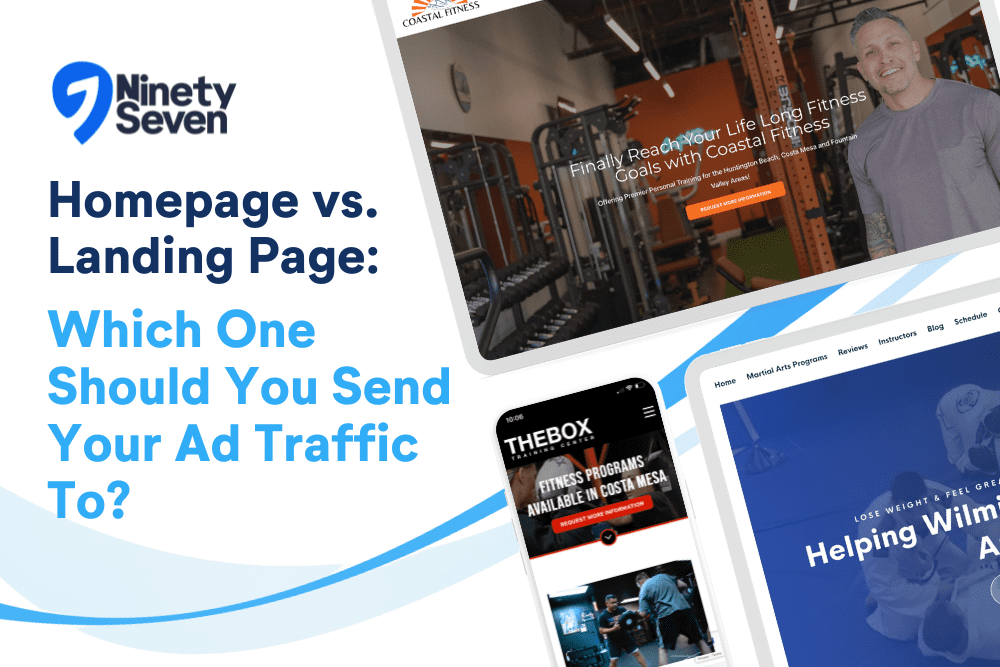
If you’re running paid ads—on Google, Facebook, Instagram, or other platforms—one decision can have a major impact on your results:
Where should that traffic go?
Many businesses automatically send ad traffic to their homepage. It feels like the safest choice. After all, it represents your brand, your services, and your credibility in one place.
But when it comes to paid advertising, that choice often limits performance.
For fitness studios, martial arts schools, and other local service businesses, understanding the difference between a homepage and a landing page—and knowing when to use each—is essential for turning ad clicks into real results.
A homepage serves as a general introduction to your business. It’s built to support many different visitors at different stages of awareness, including:
People discovering your brand for the first time
Visitors exploring multiple services
Parents researching programs
Existing members returning for information
Because of this, homepages usually include:
Navigation menus
Multiple services or programs
Brand storytelling and credibility elements
Several calls-to-action
A homepage is designed for exploration, not precision.
Organic search traffic
Direct traffic
Referral traffic
Brand awareness campaigns
In these scenarios, visitors expect options and want to browse.
Paid advertising campaigns
Offer-based promotions
Lead generation goals
When someone clicks an ad, they aren’t looking to explore everything—you’ve already captured their interest with a specific message.
A landing page has one purpose: convert a visitor into an action.
There are no navigation menus. No extra links. No competing messages.
Every element on a landing page supports a single goal, such as:
Booking a free trial
Claiming a special offer
Scheduling a consultation
High-performing landing pages focus on:
One audience
One offer
One clear call-to-action
This focused approach is why landing pages consistently outperform homepages for paid traffic.
Across industries—and especially in fitness and martial arts—the performance gap is clear:
| Metric | Homepage | Landing Page |
|---|---|---|
| Conversion Rate | Low to Moderate | High |
| Bounce Rate | Higher | Lower |
| Message Clarity | Broad | Focused |
| Ad-to-Page Match | Weak | Strong |
| Lead Quality | Inconsistent | More Qualified |
For paid campaigns, landing pages often convert 2–5 times better than homepages.
A fitness studio runs ads promoting:
“6-Week Transformation Challenge – Limited Spots Available”
The ad sends traffic to the homepage.
Visitors land on a page featuring:
Group training
Personal training
Nutrition coaching
Schedules
Blog content
Even if the challenge exists on the site, it’s competing with too many other options. Visitors hesitate, browse, or get distracted—and many leave without taking action.
Now imagine the same ad sends traffic to a dedicated landing page built specifically for the challenge:
Headline: “Join Our 6-Week Transformation Challenge”
Clear benefits (fat loss, accountability, coaching)
Before-and-after results
Testimonials from participants
Urgency or limited availability
A simple form to claim a spot
The offer is clear, focused, and easy to act on—resulting in far stronger conversion rates.
A martial arts school runs Google Ads for:
“Kids Martial Arts Near Me”
Visitors arrive on the homepage and see:
Kids programs
Adult programs
Leadership training
Birthday parties
Camps and events
Parents skim, get interrupted, or feel overwhelmed by choices.
Now the ad sends traffic to a page built specifically for parents of children:
Headline: “Help Your Child Build Confidence, Focus, and Discipline”
Short instructor video
Benefits parents care about
Reviews from other families
Offer: Free Intro Class
The page answers one clear question:
“Is this right for my child?”
That clarity removes hesitation and encourages action.
One of the most common reasons ads underperform is message mismatch.
If your ad promises:
“Free Trial Class”
But the page starts with:
“Welcome to Our Academy”
The connection breaks—even if the offer exists somewhere on the site.
Landing pages maintain message continuity by repeating:
The same language
The same promise
The same intent
This not only improves conversions but also helps ad platforms optimize for better results over time.
There are scenarios where sending traffic to a homepage is appropriate:
Brand awareness campaigns
Retargeting warm audiences
Organic traffic growth
Referral-based visits
But for paid traffic tied to a specific offer, a homepage is rarely the best-performing option.
When ad campaigns struggle, the issue is often blamed on:
Targeting
Budget
Ad creative
In reality, the destination page is frequently the bottleneck.
Paying for clicks that don’t convert doesn’t just waste ad spend—it also feeds poor data back to the ad platform, making optimization harder over time.
Landing pages provide clearer conversion signals, helping campaigns improve rather than stall.
Use your homepage when:
Visitors want to explore
The goal is brand introduction
Traffic is organic or referral-based
Use a landing page when:
You’re running paid ads
You’re promoting a specific offer
You want measurable actions
For fitness studios and martial arts schools focused on growth, landing pages aren’t optional—they’re foundational.
Your homepage is your digital storefront.
Your landing page is your closer.
If you’re investing in advertising, send traffic to a page designed to convert—not one designed to show everything at once. Focused pages create focused results, and focused results drive growth.
We offer Pay Per Click advertising. Click to learn more.
We build high performing websites click to learn more.